Used vehicles are financed across Canada every day — at dealerships, through banks and credit unions, and through lenders that specialize in auto finance. What surprises many buyers is that used car financing is often evaluated a little differently than a loan on a brand-new vehicle, because the vehicle itself forms part of the lending decision. A lender isn’t only looking at your income, your credit and how settled your situation is; it may also look at the age, kilometres, condition and value of the specific car you’ve chosen.
That changes how you should shop. Two applicants with very similar finances can receive different answers simply because one picked a newer, lower-kilometre vehicle from a dealership and the other picked an older one from a private seller.
Rates, terms and requirements vary by lender, by applicant and by vehicle, and there are no universal numbers that apply across the country. This guide explains how the process generally works, what lenders tend to look at, what to verify on a second-hand vehicle before you commit, and what to have ready before you apply.
The Short Version
- Used vehicles can be financed at dealerships, through banks and credit unions, or through lenders that focus on used-vehicle lending.
- A vehicle’s age, kilometres, condition and value can all influence what a lender is willing to finance.
- Private-sale purchases are financed by fewer lenders and usually involve extra documentation and extra steps.
- A lien search and a vehicle history check help protect you before you sign anything.
- Rates, terms and approval requirements differ by lender and by applicant — there are no universal numbers.
How Used Car Loans Work in Canada
Your vehicle is usually the security for the loan
A vehicle loan is normally a secured loan. That generally means the lender registers a financial interest against the vehicle you’re buying, and that interest typically stays in place until the loan is paid out. The vehicle is what backs the money being advanced.
This is a big part of why the car matters so much to the decision. The lender is assessing you, but it’s also assessing the asset attached to the loan — how old it is, how far it has been driven, what shape it’s in and what it would reasonably be worth if it ever had to be sold. It’s also why a used vehicle you’re looking at may already have a lien registered against it from a previous owner’s loan, something we come back to further down the page. If you’re wondering how any of this applies if this is your first vehicle loan, the basics are worth reading alongside this guide.
Where used-vehicle financing usually comes from
Broadly speaking, used-vehicle financing in Canada tends to come from three kinds of sources:
- Dealership-arranged (indirect) financing. You apply at the dealership, and the dealership submits your application to the lenders it works with.
- Banks and credit unions. You apply directly for a vehicle loan, or in some cases use another credit product to buy the car outright.
- Lenders that focus on used-vehicle or non-prime lending. Some lenders build their programs around older vehicles, higher kilometres, or applicants whose credit history needs more context.
Each channel has its own paperwork, its own criteria and its own range of available terms, and those details can differ from one lender to the next.
How used-vehicle lending tends to differ from new-vehicle lending
New vehicles often have manufacturer-supported financing programs behind them — promotional structures tied to a specific brand and model year. Used vehicles typically don’t, so a used auto loan is more often priced and structured by the lender on its own terms.
Beyond that, the available terms on a used vehicle may be shaped by the car itself. Lenders may consider model year, odometer reading and assessed value when deciding how long they’re comfortable lending for. Approval conditions can also vary more from vehicle to vehicle than they do on new inventory, where units are essentially identical. In practice, that can mean a second-hand purchase involves a bit more back-and-forth, and the answer depends on the vehicle and the applicant together.
Explore Your Financing Options
Dealership Financing vs. Buying From a Private Seller
Financing through a dealership
When you finance at a dealership, one application can often be reviewed by lenders the dealer works with, which may save you from applying in several places yourself. Dealers also commonly handle much of the administrative work: the sales paperwork, safety or certification steps where they apply, and registration details.
Convenience isn’t the same as the best structure, though. It’s worth comparing what you’re offered rather than accepting the first monthly payment quoted to you. A lower payment can simply mean a longer term — more months of interest and slower equity building — which is covered in more detail below. Ask what the rate is, how many months the term runs, and what the total amount financed is, not just what comes out of your account each month.
Dealer-sourced vehicles are also often easier to finance, because they’ve usually been inspected, reconditioned and documented before they reach the lot. If you’d like to see the kind of vehicle that fits this category, you can browse available used vehicles to get a sense of pricing and condition.
Financing a used car from a private seller
Private-sale financing exists, but fewer lenders offer it. Those that do often ask for additional documentation about both the vehicle and the seller, and some advance funds directly to the seller rather than handing money to you.
Steps a buyer commonly has to arrange personally in a private sale include:
- A properly completed bill of sale
- Proof that the seller actually owns the vehicle
- A lien search on the vehicle
- An independent mechanical inspection
- Registration and transfer of ownership
- Any required safety or out-of-province inspection
Exactly what’s needed varies by lender and by province or territory, so confirm the requirements for your own situation before you agree to a purchase date with the seller.
Why private sales can be harder to finance
- The lender can’t rely on a dealer’s reconditioning or certification process, so the vehicle’s condition is less verified.
- Valuing one individual privately owned vehicle can be harder than valuing typical dealer inventory.
- There’s no dealership standing behind the transaction to help sort out ownership or lien complications.
- The lender’s security rests entirely on that single vehicle’s condition and history.
None of this makes a private sale a bad idea. Private purchases can be excellent value, and plenty of buyers are happy with them. They simply tend to need more planning, more documentation and a little more lead time when financing is part of the deal.
How a Vehicle’s Age, Kilometres and Condition Can Affect Approval
Age and kilometre considerations
Many lenders apply their own limits on how old a vehicle can be and how many kilometres it can have. Older or higher-kilometre vehicles may still be financed, but sometimes for a shorter term, and sometimes by fewer lenders.
There is no national standard here. Age and odometer parameters are not standardized in Canada — they’re set lender by lender and can change over time. Treat any figure you hear quoted as a general cut-off with healthy skepticism, and ask the specific question about the specific vehicle you’re considering.
How lenders look at the vehicle’s value
Lenders generally weigh what the vehicle appears to be worth against the amount being financed. That’s why purchase price, kilometres, trim and options, overall condition and general market value tend to come into the picture.
The practical takeaway: a vehicle priced noticeably above its assessed value can complicate an approval, even when the applicant’s own profile is strong. Paying close to fair value for a used vehicle is one of the simplest ways to keep a financing application straightforward.
Vehicles that may be harder to finance with some lenders
- Rebuilt or salvage-branded vehicles — the brand can affect resale value and, in some cases, insurability.
- Vehicles with reported accident or flood history — condition and long-term value are harder to rely on.
- Previously written-off vehicles — an earlier claim can affect what the vehicle is worth today.
- Out-of-province vehicles needing inspection — the paperwork and inspection add verification steps.
- Grey-market or imported vehicles — history and specifications can be harder to verify.
- Heavily modified vehicles — modifications can complicate valuation and insurance.
- Vehicles with an unresolved lien — a lender generally can’t take clear security until an existing interest is cleared.
Check the Vehicle Before You Commit: Liens, History and Inspection
Why a lien on a used vehicle matters
A registered lien means another party already has a financial interest in that vehicle — often because a previous owner financed it and the loan hasn’t been paid out. If it isn’t cleared before the sale closes, it can create serious problems for you as the new owner.
In Canada, lien registries are generally maintained at the provincial or territorial level, so a lien search is done through the appropriate registry. Because processes and access points differ, confirm the current procedure where you live rather than assuming what worked elsewhere applies. If a search turns up a lien, it should be resolved before money changes hands.
Vehicle history reports
A history report can reveal reported accident or insurance claims, registration history across provinces, recorded odometer readings, and whether the vehicle carries a brand such as rebuilt or salvage.
Understand the limitation, though: a report shows what was reported, not necessarily everything that happened. Repairs paid for privately, or damage never claimed, may simply not appear. A clean report is reassuring, not conclusive.
Pre-purchase inspection
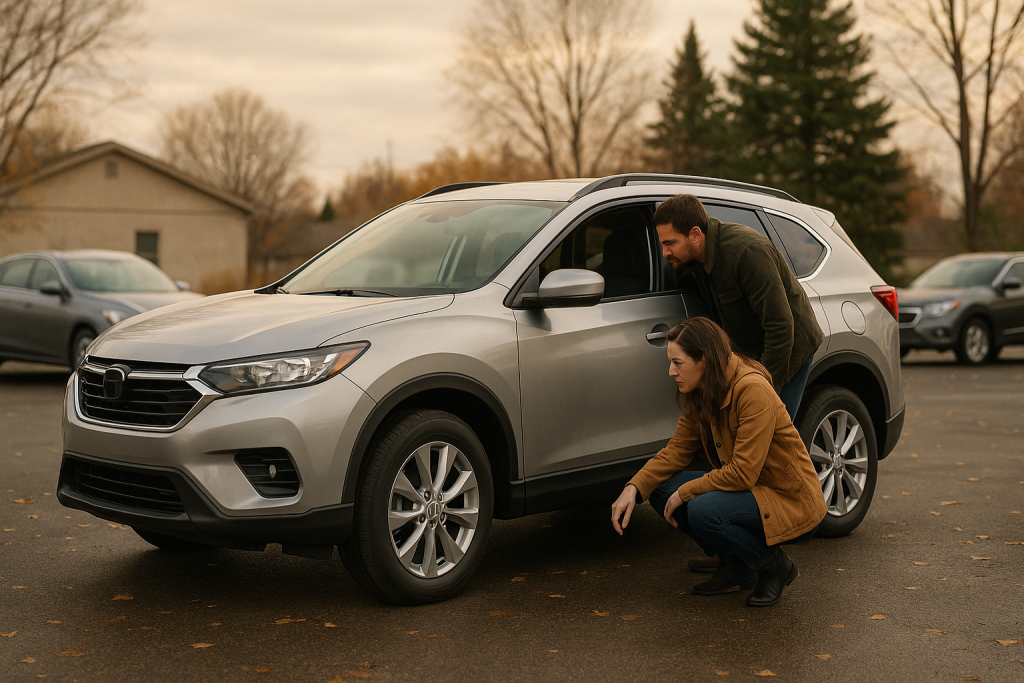
An independent mechanical inspection is one of the better small investments you can make, and it matters most on a private sale or on an older, higher-kilometre vehicle. Have someone who isn’t connected to the sale look at it.
Safety-standards requirements and out-of-province inspection rules vary by province and territory, so confirm what applies where you live and where the vehicle is coming from. There’s a financing angle too: repairs identified early change what the vehicle is genuinely worth, and therefore what you should be willing to finance.
Used Car Loan Requirements: What Lenders Commonly Ask For
Requirements differ by lender and by applicant — what follows is what applicants are commonly asked for, not a universal checklist.
Identification and contact details
Government-issued identification, a valid driver’s licence, your current address and contact information, and often some address history. Lenders generally want to confirm who you are and how stable your situation is.
Income and employment information
Verification methods vary quite a bit. Employed applicants, self-employed applicants, those receiving a pension and those with other income sources may each be asked to document income differently — pay statements, bank records, tax documents or a combination.
Banking and financial details
Banking information is normally needed to set up payments. Lenders also tend to want a general picture of your existing obligations and housing costs, so they can see how a new payment might fit alongside what you already pay.
Credit information
Lenders generally review your credit as part of the decision. Credit history is one factor among several — income, stability and the vehicle usually sit beside it. There is no single minimum credit score that applies across all lenders in Canada. Applicants with bruised credit are sometimes approved and sometimes not, depending on the full picture, and credit challenges can affect which vehicles a lender will approve as well as the terms offered.
Vehicle and deal information
The VIN, year, make and model, odometer reading, purchase price, bill of sale and insurance details. For a private sale, add seller information and the results of your lien search.
Down payment or trade-in
A down payment or a trade-in reduces the amount being financed, which can strengthen an application and shorten the time spent in negative equity. That said, down payment requirements are not universal — whether one is needed, and how much, depends on the lender, the applicant and the vehicle.
Loan Term, Depreciation and the Risk of Negative Equity
How term length changes the deal
Term length is the quiet variable in most vehicle deals. A longer term generally lowers the monthly payment, but you pay interest for more months and build equity more slowly. A shorter term generally does the reverse: a higher payment, less interest paid over the life of the loan, and equity that catches up faster.
Neither is automatically right. What matters is understanding the trade-off you’re making, rather than choosing a car based only on the payment figure someone quotes you.
Why this matters more on a used vehicle
A pre-owned vehicle has usually taken its steepest depreciation already, which is part of the appeal — but it keeps depreciating, and maintenance and repair costs often climb as a vehicle ages.
Stretch an older vehicle over a long term and you can end up in an uncomfortable spot: still making payments on a car that needs significant repairs, or that’s worth less than the balance owing. That combination is what can turn an affordable payment into an expensive few years.
Negative equity, in plain language
Negative equity means you owe more on the loan than the vehicle is currently worth. It can build up when a long term is combined with little or no down payment, when add-ons are rolled into the financing, or when the vehicle depreciates faster than expected.
It often doesn’t feel like a problem until later — when you want to trade in, or if the vehicle is written off in a collision and the insurance settlement comes in below your remaining balance. Some buyers look at protection products aimed at this exposure; coverage details, cost and availability vary entirely by product and provider, and add-ons are discussed in the next section.
Two practical habits help: choose the shortest term your budget genuinely supports, and ask how early payout works before you sign.
Questions to ask about your contract
- Is the interest rate fixed?
- What is the total amount financed?
- Are there fees, and what are they for?
- How is early payout or prepayment handled?
- Is there a penalty or cost for paying out early?
- Are there conditions attached to the approval?
Extended Warranties and Other Add-Ons
Several products are commonly offered alongside a used vehicle: extended warranty or mechanical-breakdown protection, protection products related to the loan balance, tire-and-rim coverage, appearance packages and prepaid service plans. Terms, coverage, exclusions and cost vary entirely by provider and product, so whether any specific one represents good value depends on the details in front of you.
Here’s the part that’s easy to miss: an add-on rolled into the loan increases the amount financed, which means you generally pay interest on it across the whole term. On an older vehicle where repair risk is real, that can be a reasonable trade. On a product that duplicates coverage you already have, or that you’d rarely use, it’s an expensive line item.
Before agreeing to anything, ask:
- What exactly is covered, and what’s excluded?
- How long does it last, and to how many kilometres?
- Who administers it, and where can it be used?
- Is it transferable if I sell, or cancellable if I change my mind?
- What does it add to my total amount financed and my payment?
- Is any add-on a condition of the financing, or is it optional?
How to Approach Used Car Financing, Step by Step
- Set a realistic total budget. Look past the payment: insurance, fuel, maintenance, expected repairs on an older vehicle, and registration costs all belong in the number.
- Review your own credit and financial picture. Knowing roughly what a lender will see before you apply means fewer surprises in the conversation.
- Gather your documents in advance. Use the requirements section above as a guide — identification, income, banking. Preparation tends to speed things up considerably.
- Look at financing before you fall in love with a vehicle. Depending on the lender, submitting an application or pre-qualifying first can give you a more realistic shopping range and take pressure out of the moment you’re sitting at a desk deciding. You can see how our financing process works if you’d like to know what to expect before starting.
- Shop within that range and choose the vehicle carefully. Remember that the vehicle itself can affect the approval, not just your finances.
- Verify the vehicle. Lien search, history report, independent inspection, odometer and VIN check, and any out-of-province requirements.
- Compare what you’re offered, not just the payment. Rate, term, total amount financed, fees, add-ons and any conditions attached.
- Read the contract before signing. Confirm the numbers match what was discussed out loud, and ask about anything that isn’t clear. A good lender or dealer will not mind the questions.
- Complete insurance, registration and transfer. Make sure you understand when your first payment comes out and how payments will be taken.
Practical tips before you apply
- Keep your documentation accurate and complete — gaps tend to slow things down more than anything else.
- Be cautious about taking on new debt while an application is in progress.
- Consider a down payment or trade-in to reduce the amount financed.
- Choose a vehicle priced in line with its value rather than above it.
- Be realistic about term length instead of chasing the lowest possible payment.
- Ask what conditions are attached to any approval before you plan around it.
- Remember that outcomes depend on your full circumstances and each lender’s criteria — no one can promise an approval.
Frequently Asked Questions
Is it harder to finance a used car than a new one?
Not necessarily harder, but it is often evaluated differently. With a used vehicle, the car’s age, kilometres, condition and assessed value can form part of the lending decision, alongside your income, credit and stability. Used vehicles also typically don’t come with manufacturer-supported financing programs, so the loan is more often structured by the lender on its own terms. Plenty of second-hand purchases are financed without difficulty — the process just tends to involve more attention to the vehicle itself.
Can you finance a used car in Canada with bad credit?
Some lenders do work with applicants who have damaged or limited credit history. Credit is one factor among several: income, stability, the amount being financed and the vehicle can all matter too. Approval is never guaranteed, and the terms available vary by lender and by applicant.
Can I get financing for a car I’m buying from a private seller?
Sometimes, yes, but fewer lenders offer private-sale financing and more documentation is usually required — a bill of sale, proof the seller owns the vehicle, a lien search and often an inspection. Where it’s available, funds are frequently advanced directly to the seller rather than paid to you. Requirements differ by lender and by province, so confirm what’s needed before you commit to a closing date.
Is there a maximum age or mileage a lender will finance?
Many lenders set their own limits on model year and odometer reading, and there is no single national standard in Canada. Older or higher-kilometre vehicles may still be financed, but they may qualify with fewer lenders, or for shorter terms. Because these parameters aren’t standardized and can change, it’s best to ask about the specific vehicle you’re considering rather than relying on a general rule you’ve heard.
Do I need a down payment to finance a used vehicle?
A down payment isn’t universally required. It can help in real ways: a down payment or trade-in reduces the amount financed, may strengthen an application and shortens the period where you owe more than the vehicle is worth. Whether one is needed at all, and how much, depends on the lender, your circumstances and the vehicle being purchased.
How do I find out if a used car has a lien on it?
Lien registries in Canada are generally maintained provincially, so a lien search is usually done through the appropriate provincial registry or through a service that searches it on your behalf. Processes and access points differ, so confirm the current procedure where you live. Run the search before money changes hands, and make sure any registered lien is resolved before the purchase is completed — not afterwards.
Financing a Used Vehicle in Canada — Where to Start
If you’re shopping for a pre-owned vehicle and want a clearer sense of your financing options before you start negotiating, you can submit an online vehicle financing application through AutoApprovalsCanada.ca.
Approval, rates and terms aren’t guaranteed — they depend on your circumstances, each lender’s criteria and the vehicle you choose. Taking the time to compare what you’re offered is always reasonable.